
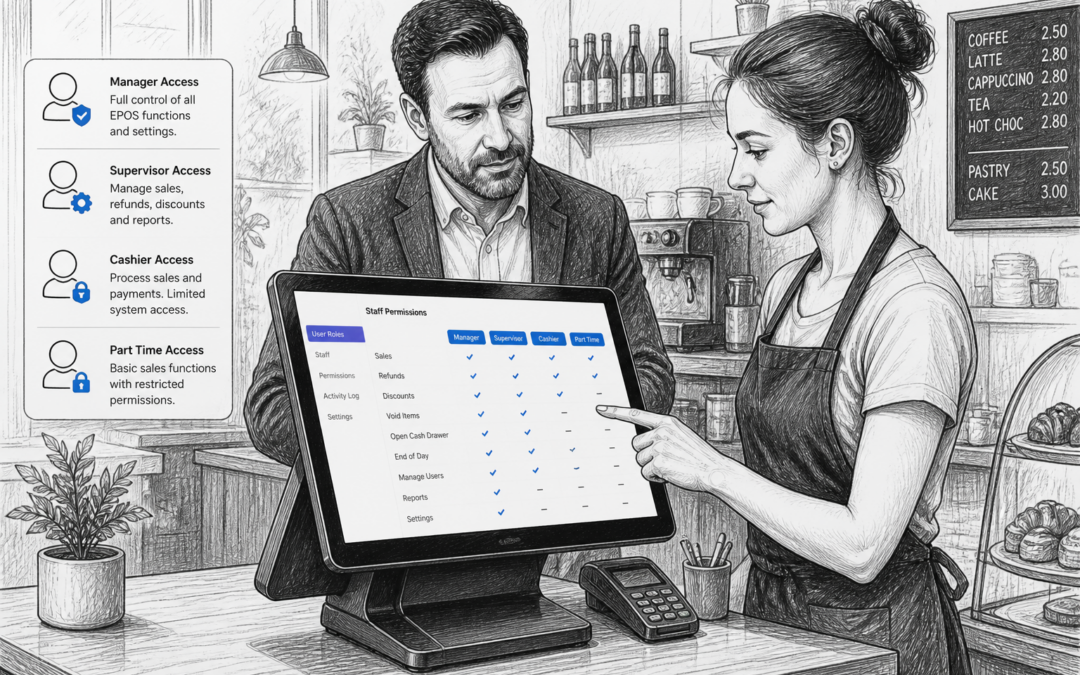
Why staff permissions matter in everyday EPOS use
For many UK retail and hospitality businesses, the till is used by multiple people across shifts, departments and busy service periods. That is why staff permissions are more than a back-office setting. They help decide who can refund, discount, delete items, change prices, open the till or access reports.
When permissions are set properly, day-to-day trading becomes more controlled and less reliant on memory or verbal instructions. Staff can still do their jobs quickly, while managers keep better oversight of what is happening on the system.
Whether you run a convenience store, café, restaurant, pub or takeaway, the right EPOS setup can make it easier to keep service moving without giving every user the same level of access.
What staff permissions actually do
Staff permissions allow you to define what each team member can see and change on the EPOS system. In practical terms, this may include:
- allowing supervisors to process refunds or voids
- restricting discounts to managers only
- limiting access to reporting or end-of-day functions
- controlling who can edit products or prices
- setting different access levels for full-time staff, part-time staff and seasonal workers
This matters because not every task should sit with every user. A simple setup can reduce errors, help protect cash flow and keep sensitive settings away from casual users.
Helping staff work confidently
Good permissions do not slow staff down when they are configured properly. In fact, they can make the till easier to use because each person sees the tools they need and fewer of the ones they do not.
That can be especially useful in a busy café or takeaway where team members need to take orders quickly. It also helps in retail shops where different staff may handle sales, customer queries and administration.
Benefits for retail businesses
In retail, staff permissions are often used to keep pricing changes and refunds under control. This is useful in businesses such as fashion shops, gift shops, hardware stores and multi-department retail operations, where stock and pricing can vary across product ranges.
A well-managed EPOS system can help reduce avoidable mistakes. For example, if a junior member of staff needs approval before applying a discount, the business has a clearer record of what was done and why. That can make tills easier to review at the end of the day.
For independent retailers, permissions also support consistency across different shifts. If you have one person working the morning and another handling the close, each can use the EPOS system in a way that matches their role.
Benefits for hospitality businesses
In cafés, restaurants, bars, pubs and takeaways, service speed matters just as much as control. Staff permissions can help you balance both. For example, a server may need to place orders and print bills, while only a manager can refund a payment or amend a closed ticket.
This is especially useful during busy periods when the counter or table service area is under pressure. If every user can make advanced changes, mistakes are more likely. If too few people can access essential functions, service can slow down. The right permissions give you a useful middle ground.
They can also support order accuracy. When changes are restricted properly, there is less risk of accidental edits to items already sent to the kitchen or bar.
Why permissions are worth thinking about before busy periods
Permissions become even more important before weekends, holidays and seasonal peaks. During those times, you may bring in temporary staff or rota people across unfamiliar roles. A sensible EPOS setup means new starters can take payments and serve customers without needing access to areas they do not use.
This reduces the pressure on managers and makes training simpler. Rather than teaching every staff member every function, you can focus on the tasks that matter for their role.
Better control without slowing service
Some business owners worry that added controls will make the till harder to use. In practice, a good EPOS system should do the opposite. It should let colleagues move quickly through common tasks while protecting the functions that need more oversight.
That balance is important whether you are behind a counter, serving tables or running a busy multi-site operation.
Why local EPOS support still matters
Even with a well-designed system, you may still need help setting up permissions correctly or adjusting access as your team changes. This is where local support can make a real difference for UK businesses.
Local EPOS support is useful because it understands how independent retailers and hospitality venues actually work day to day. You may need help with shift patterns, manager overrides, permissions for seasonal staff or reorganising access after a business change. A UK-based support contact can often make those conversations quicker and more practical.
For businesses that want straightforward advice rather than generic guidance, that local support can be just as valuable as the software itself.
Choosing an EPOS setup that fits your team
If you are comparing EPOS systems, look for one that lets you set permissions in a simple, sensible way. You should be able to give staff enough access to do their jobs without opening up functions that should stay restricted.
Samtouch is one UK EPOS option that supports this kind of practical day-to-day control for retail and hospitality businesses. It is designed to help businesses manage sales, staff access and operational routines in a way that feels manageable rather than overcomplicated.
If staff permissions are something you have not reviewed for a while, it may be worth taking another look. A few small changes can make your till setup more secure, more consistent and easier for your team to use.
Contact YCR Distribution at sales@samtouch.co.uk 01924 438238 or visit www.samtouch.co.uk to find out more.
Recent Comments