
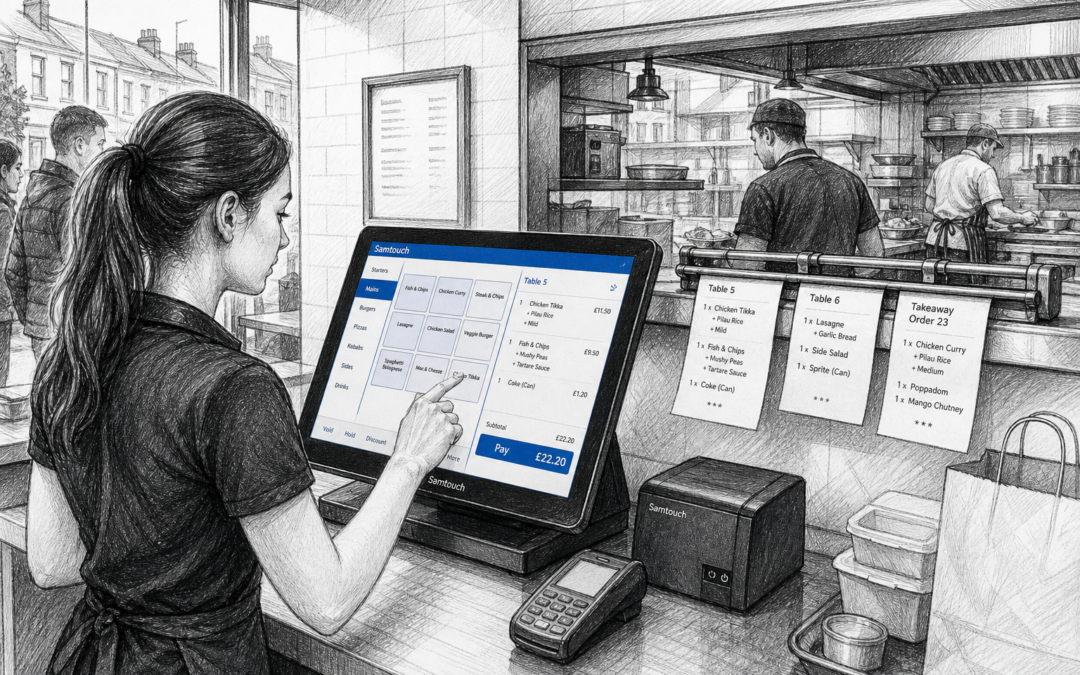
In busy restaurants and takeaways, order accuracy is not just a nice extra. It affects service speed, customer satisfaction and how smoothly the kitchen can work. When a table’s order is entered wrongly, or a takeaway ticket is missed or misread, the knock-on effect can be immediate: delays, waste, refunds and avoidable stress for the team.
A good EPOS system helps reduce those risks by making order entry clearer and more consistent. For UK food businesses, that can make a real difference during lunch rushes, evening peaks and weekend trading.
Why order accuracy matters so much
Even small mistakes can create bigger problems in hospitality. A missing side, a wrong table number or a confused modifier can slow service and upset guests. In takeaways, where customers are often ordering quickly and expecting collection on time, accuracy is even more important.
Improving accuracy also helps the business internally. Staff spend less time correcting mistakes, the kitchen receives clearer instructions, and management has fewer disputes to deal with. That means the team can focus on serving customers properly rather than fixing errors.
How EPOS software helps improve accuracy
Clearer order entry
EPOS screens can be set up so staff select items from a clear menu rather than writing orders by hand or relying on memory. This reduces the chance of misunderstandings, especially when items have multiple options such as sauces, sides, cooking preferences or drink sizes.
For restaurants and takeaways, this is useful for both front-of-house teams and counter staff. A well-organised menu layout makes it easier to enter the correct item first time, even during a busy service.
Modifiers and special requests
Many order errors happen when special instructions are not passed on properly. EPOS software can help by allowing common modifiers to be attached to items in a structured way. That means requests such as “no onions”, “extra cheese” or “gluten-free” are easier to capture and display clearly.
Instead of handwritten notes or unclear shorthand, the kitchen receives a cleaner order that is easier to follow. This can be especially helpful in businesses that serve a wide range of customisable dishes.
Better communication with the kitchen
When paired with a kitchen printer or kitchen display, EPOS can send orders directly to the right place in the right format. That helps reduce reliance on verbal relaying between the till and the kitchen, which is where mistakes often creep in.
For takeaways, the benefit is straightforward: orders are printed or displayed as soon as they are entered, helping the kitchen work from one clear record rather than several scattered notes.
Consistent order handling across the team
One of the strengths of EPOS is consistency. New starters, part-time team members and experienced staff can all use the same system and follow the same process. That helps reduce variation in how orders are taken, which is useful in businesses with shift patterns or seasonal staff changes.
It also makes training simpler. Rather than learning several different ways of taking an order, staff can be trained on one standard process.
Why this is especially useful for UK restaurants and takeaways
UK hospitality businesses often have to manage busy peak periods, changing menus and customer expectations around speed. A restaurant may need to deal with table service, collection orders and delivery tickets at the same time. A takeaway may have to keep walk-ins, phone orders and online orders moving without confusion.
EPOS software helps bring those orders into one manageable system. That makes it easier to keep service consistent, even when the pace picks up. It also supports better record-keeping, which can be useful when reviewing busy periods or checking where mistakes are happening.
Why local EPOS support still matters
For UK restaurants and takeaways, support is more than a technical detail. When a system needs adjusting during a busy service, it helps to have someone who understands how local businesses actually operate. A UK-based EPOS provider is more likely to understand VAT requirements, trading patterns, staff training needs and the realities of hospitality service.
Local support can also make setup and day-to-day use feel more practical. If you are introducing a new EPOS system, or refining an existing one, it helps to work with a provider that can explain things clearly and respond in a way that suits UK businesses. Samtouch is built for this kind of environment, offering practical EPOS support for retail and hospitality operators through www.samtouch.co.uk.
Choosing the right EPOS features for your venue
If order accuracy is a concern, it is worth looking at how your system handles menus, modifiers, kitchen printing and table or order tracking. The best setup is not necessarily the most complicated one. It is the one that helps your team enter orders correctly, send them quickly and keep service moving.
For some businesses, improving accuracy may start with a better touchscreen layout. For others, it may mean linking front-of-house and kitchen workflows more effectively. Either way, the goal is the same: fewer mistakes and a smoother customer experience.
Final thoughts
Order accuracy is one of the simplest ways to improve hospitality service, but it often depends on having the right tools in place. A good EPOS system can make orders clearer, reduce avoidable mistakes and help staff work with more confidence.
If you are reviewing your current setup, Samtouch offers a practical UK EPOS option for restaurants, takeaways and other hospitality businesses. Contact YCR Distribution at sales@samtouch.co.uk 01924 438238.
Recent Comments