
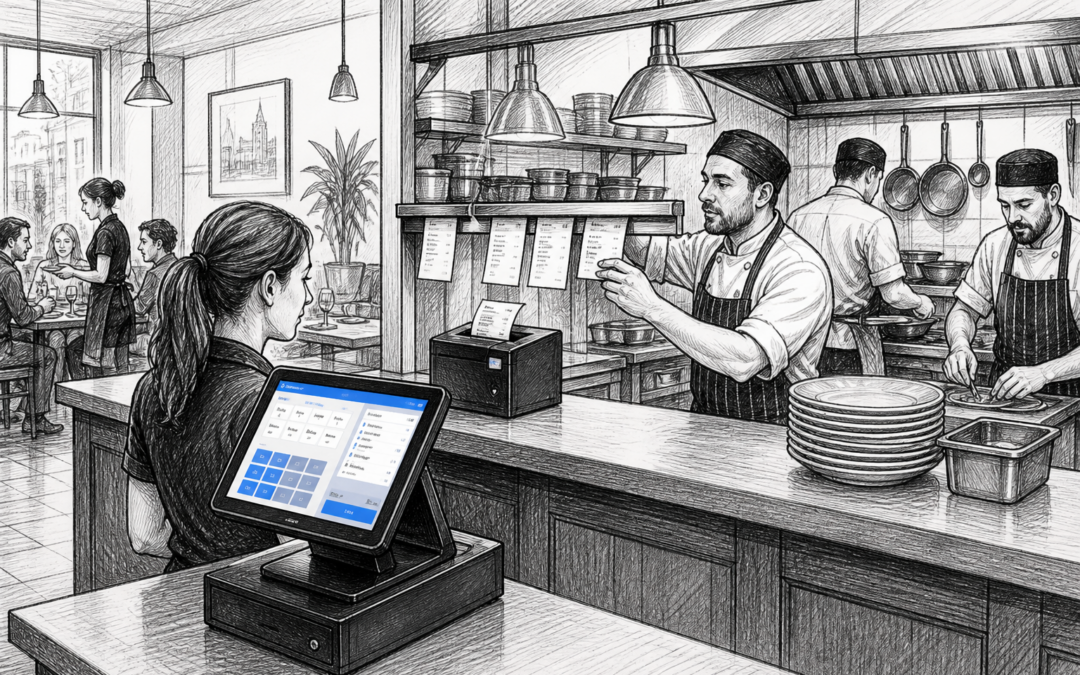
Why kitchen printing still matters in busy hospitality venues
For many UK restaurants, cafés, pubs and takeaways, the busiest moments are when small mistakes can cause the biggest problems. A missed note, an unclear handwritten ticket or a verbal order passed between staff can all lead to delays and unhappy customers. Kitchen printing helps reduce that risk by sending orders clearly from the front of house or till directly to the kitchen.
It is a straightforward EPOS feature, but one that can make service feel more organised. Instead of relying on memory or handwritten dockets, staff can print clear order tickets as soon as the customer orders. That makes it easier for kitchen teams to prepare food in the right sequence and helps front-of-house staff stay focused on serving guests.
For businesses looking to improve accuracy without complicating their workflow, kitchen printing is often one of the most practical EPOS features to consider.
How kitchen printing reduces order errors
Order accuracy is important in every hospitality setting, but it becomes especially valuable when the menu is busy, customisable or fast-moving. Kitchen printing helps by giving the kitchen a clear record of what has been ordered, including any special requests, modifiers or item notes.
Clearer communication between front of house and kitchen
When staff take an order at the counter or table, the information can be sent straight to the correct printer. This reduces the chance of details being lost between the customer, the server and the kitchen team. It is particularly useful during lunch rushes, evening service and weekend trading when staff are under pressure.
Better handling of special requests
Many customers ask for changes such as no onions, extra sauce, sauce on the side or a different cooking instruction. If those notes are printed clearly, the kitchen can act on them more confidently. That helps reduce avoidable mistakes and improves the overall customer experience.
Less dependence on memory and handwritten notes
Handwritten tickets can be difficult to read, especially in a busy or noisy environment. Printed kitchen tickets remove much of that confusion. For smaller hospitality businesses, this can be a simple way to introduce more consistency without changing the whole way the team works.
Kitchen printing in different hospitality settings
Although kitchen printing is often associated with restaurants, it is useful across a wide range of food businesses.
Cafés and lunch spots
Cafés often need to balance food orders, drinks and quick turnaround times. Kitchen printing helps baristas and kitchen staff stay on the same page, especially when customers order both hot drinks and food at the same time.
Restaurants and table service venues
In restaurants, clear ticketing supports smoother table service. Orders can be routed to the kitchen as they are taken, helping staff manage multiple tables more confidently and reducing the risk of one course being overlooked.
Takeaways and quick-service food businesses
Takeaways depend on speed and accuracy. Kitchen printing helps teams work through orders in the right sequence, which is important when customers are waiting in person or orders are being prepared for collection.
Pubs and bars with food service
Pubs serving meals often have a mixed operation, with bar drinks and food orders happening at once. Kitchen printers help separate the food side of the business from the drinks side, making it easier to manage both without confusion.
Why local EPOS support still matters
Even a simple feature like kitchen printing depends on the right setup. Printers need to be installed in the right place, connected correctly and configured to suit how the business operates. That is why local EPOS support still matters for many UK hospitality businesses.
If a printer stops working during a busy service, restaurant or café teams usually need help quickly. Local support can make a real difference because it is easier to get practical advice from someone who understands the pace and pressure of hospitality in the UK. The same is true when a business is expanding, adding a second printer or changing service areas.
For independent venues, local support is often about more than fixing faults. It can help with getting the system set up in a way that suits the business, training staff and making sure the EPOS setup continues to match the way the team actually works.
What to look for in a kitchen printing setup
Not every setup needs to be complex. The best approach is usually the one that fits the business size, menu and service style.
Reliable ticket routing
Orders should reach the correct printer without staff needing to think about it each time. This is especially useful when different items need to go to different preparation areas.
Simple menu management
If menus change regularly, the EPOS should make it easy to update item names, modifiers and notes. That helps keep kitchen tickets accurate and easy to read.
Clear, readable output
The goal is to help the kitchen work faster, not create extra clutter. Printed tickets should be tidy and consistent so that anyone on shift can follow them.
How Samtouch can help
Samtouch is a UK EPOS software solution built for retail and hospitality businesses, including cafés, restaurants, bars and takeaways. For businesses looking to improve order accuracy and service speed, kitchen printing can be part of a practical setup that supports day-to-day trading without adding unnecessary complexity.
If you are reviewing your current till system, it may be worth looking at whether your EPOS is helping staff communicate clearly with the kitchen or creating extra work. Samtouch offers a straightforward option for businesses that want a setup shaped around how they actually serve customers.
To find out more, visit www.samtouch.co.uk or contact YCR Distribution at sales@samtouch.co.uk 01924 438238.
Final thoughts
Kitchen printing may seem like a small feature, but in a busy hospitality business it can support clearer communication, fewer errors and smoother service. For UK restaurants and similar venues, that can mean less stress for staff and a better experience for customers. If your team still relies on handwritten notes, verbal calls or a basic till setup, it may be time to consider whether a more organised EPOS system would make life easier.
Recent Comments