
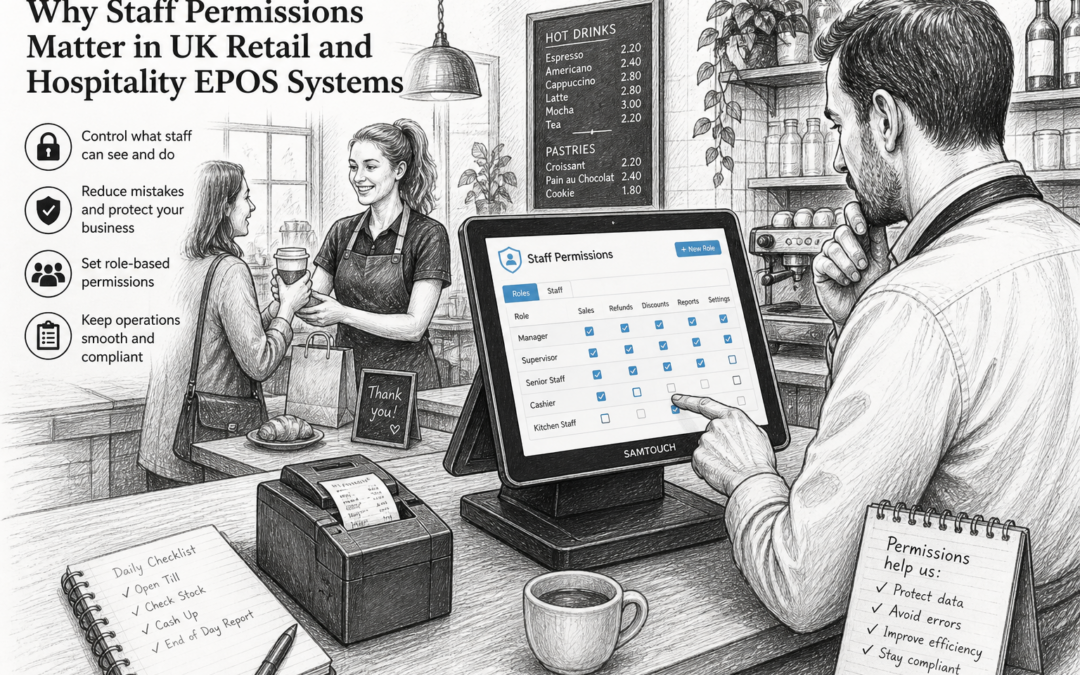
For many UK retailers, cafés, restaurants, bars and takeaways, the till is used by more than one person every day. That can work well, but only if each team member has access to the right functions. This is where staff permissions become an important part of a good EPOS setup.
Staff permissions let business owners control what each member of staff can do on the system. For example, one person may be able to take payments and print receipts, while a supervisor may also be able to void items, issue refunds or change prices. Used well, this is a practical way to protect margins, reduce mistakes and keep control without slowing service down.
What are staff permissions in EPOS?
Staff permissions are user settings that limit access to certain actions, menus or reports within your EPOS software. Rather than giving every member of staff the same access, you can assign different roles based on responsibility.
Typical permission levels might include:
- Basic till access for taking orders and payments
- Supervisor access for refunds, discounts and voids
- Manager access for reporting, cashing up and settings changes
- Admin access for user setup and wider system control
This approach is common across retail and hospitality businesses because it helps keep operations tidy and reduces the chance of accidental changes.
Why staff permissions are useful for UK businesses
In busy trading environments, small errors can quickly add up. A rushed refund, an unapproved discount or an incorrect price change can affect takings and create confusion at the end of the day. Staff permissions help reduce those risks by making sure only the right people can carry out sensitive actions.
They are also helpful for training. New starters can be given a simple access level at first, so they can focus on learning the till, the menu or the product range without being overwhelmed by too many options. As they gain confidence, their access can be widened where appropriate.
For businesses with several branches or mixed teams, permissions can help keep standards consistent. In a retail store, that might mean only managers can alter prices or approve returns. In a café or takeaway, it could mean only senior staff can cancel orders after payment has been taken.
How staff permissions support better control
One of the main benefits is accountability. When each employee has their own login, it is easier to see who carried out a transaction or made a change. That can be valuable if there is a query about a refund, discount or till variance.
Permissions also support cash handling. If only certain staff can access cash-up functions or end-of-day reporting, it becomes easier to keep an accurate record of what happened during the shift. That does not remove the need for good procedures, but it does give business owners an extra layer of control.
Another benefit is customer service. Staff can still serve quickly at the front counter or table, but the system can be set up so that less common or higher-risk actions need approval. That helps balance speed with oversight.
Retail and hospitality: different settings, same need for control
Although the details vary, the principle is the same across sectors. In retail, permissions may be used to manage refunds, price changes, discounts and access to reports. In hospitality, they are often used to control order edits, voids, split bills and access to sensitive menu settings.
For a convenience store or gift shop, permissions may help protect against unauthorised discounts or error-prone returns. For a restaurant, they may help manage table orders and reduce confusion when multiple servers use the same EPOS terminal. For a bar or pub, they can be especially useful during busy periods when several staff are serving at once.
Why local EPOS support still matters
Good staff permissions are only useful if they are set up properly from the start. That is one reason local EPOS support still matters for UK retail and hospitality businesses. A UK supplier understands how businesses work on the ground: different shift patterns, staff turnover, bank holiday trading, and the practical pressure of keeping service moving.
With local support, business owners can talk through how their team actually works and set permissions accordingly. A takeaway may need a different structure from a fashion shop. A café may want supervisors to approve refunds, while a multi-department retailer may need managers to access separate reporting functions. That kind of setup is easier when the support team understands the day-to-day realities of UK businesses.
Samtouch, available at www.samtouch.co.uk, is a practical UK EPOS software option for businesses that want sensible control without unnecessary complexity. It is designed to support real working environments, where staff need to serve customers efficiently while management keeps oversight in the background.
How to think about permissions when choosing EPOS software
If you are reviewing your current system, it helps to ask a few simple questions:
- Can I give different access levels to different members of staff?
- Can I limit refunds, voids or discounts to supervisors?
- Can I see which user carried out a transaction or adjustment?
- Can permissions be changed easily as staff join, move roles or leave?
- Will the system suit both busy service periods and quieter admin tasks?
If your current setup makes these tasks awkward, or relies too much on written notes and workarounds, it may be time to consider a more structured EPOS solution.
Bringing control and simplicity together
Staff permissions are not about making work difficult. They are about putting the right guardrails in place so that teams can work quickly and confidently. For UK businesses, that balance matters. A good EPOS system should help staff serve customers, while giving owners the control they need to protect the business.
If you are looking for a UK EPOS solution with practical features for retail and hospitality, Samtouch is worth exploring. Contact YCR Distribution at sales@samtouch.co.uk 01924 438238 or visit www.samtouch.co.uk to learn more.
Recent Comments