
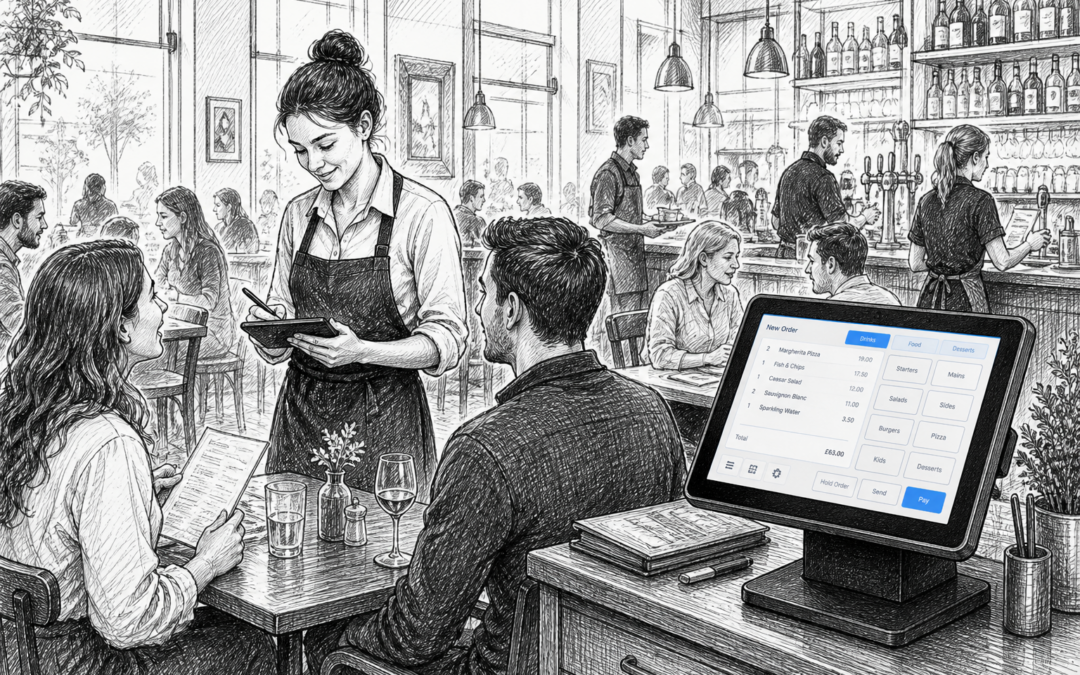
For many UK restaurants, cafés and bars, the busiest moments are also the ones where mistakes can creep in. Orders are taken in a hurry, tables change quickly, and staff may be juggling drinks, food service and card payments at the same time. A well-designed table service EPOS can make that process much easier to manage.
Rather than relying on handwritten notes, memory or repeated trips back to the till, table service EPOS lets teams capture orders clearly and send them straight into the right workflow. That can improve service speed, reduce confusion and give staff more time to focus on guests.
What table service EPOS does for hospitality teams
Table service EPOS is built to support service on the shop floor. In a restaurant or café, that usually means taking orders at the table, splitting items by course where needed, sending drinks or food to the right place, and keeping track of what each table has ordered.
For pubs and bars, the same approach can make it easier to handle food service alongside drinks, especially when one team member is serving several areas at once. In practical terms, the system becomes part of the service flow rather than just a payment point.
Helps staff work faster without rushing guests
When staff can enter an order once and send it directly to the kitchen or bar, there is less need for double handling. That saves time and reduces the chance of missed items. It also helps new or temporary staff feel more confident because the process is clearer and more consistent.
For independent businesses, that can be particularly useful during lunch rushes, weekend evenings or seasonal spikes. Instead of every order depending on memory or paper notes, the EPOS gives the team a more reliable way to keep service moving.
Improves order accuracy at the table
Accuracy matters in hospitality. A small mistake such as a missing side, the wrong drink or an extra allergen note can affect the customer experience and create extra work for the team. Table service EPOS helps reduce these issues by making orders easier to read and easier to send on correctly.
It can also support clearer communication between front of house and the kitchen or bar. When order details are entered properly at source, there is less scope for confusion later in the service.
Why table service matters for customer experience
Customers in restaurants and cafés usually notice speed and confidence before anything else. They want to be greeted promptly, have their order taken without fuss and receive their food or drinks with minimal delay. Table service EPOS supports that by helping staff stay organised and responsive.
It also makes service feel more polished. When team members can check table details quickly, add items without delay and handle payments smoothly, the whole experience feels more professional. That is important for independent venues competing on service as much as on menu or price.
Useful for bars and pubs, not just restaurants
Although table service is often associated with restaurants, it can be just as helpful in pubs and bars that serve food. Mixed-service venues often need to manage drinks at the bar and food orders at tables, sometimes with different staffing levels at different times of day.
A flexible EPOS system can help bring that together. Staff can serve customers where they are, rather than asking them to queue unnecessarily, which is often a better fit for modern hospitality service.
Local support still matters for UK hospitality businesses
When hospitality businesses choose EPOS software, they are not only buying a system. They are also choosing the support behind it. That is where local EPOS support still matters for many UK restaurants, cafés and bars.
If a table service setup needs adjusting before a busy weekend, or staff need help understanding how to use a feature properly, fast and knowledgeable support can make a real difference. Local support is often easier to relate to the way UK venues actually operate, whether that is service charge handling, VAT concerns, peak-time trading or staffing changes.
For independent operators, that practical support can be more valuable than a generic help process that does not understand day-to-day hospitality pressures. Samtouch, available at www.samtouch.co.uk, is designed with UK retail and hospitality businesses in mind, so the focus stays on helpful, usable systems rather than unnecessary complexity.
Choosing the right setup for your venue
Not every business needs the same features. A café may want faster table ordering and simple payments, while a restaurant may need stronger table management and smoother kitchen communication. Pubs and bars may prioritise quick order entry and reliable service under pressure.
The best EPOS setup should match the way your team works now, while leaving room to grow. That might include handheld ordering, kitchen printing, payment speed, reporting or customer service features, depending on the venue.
If you are still relying on a basic till or a manual process, table service EPOS can be a practical next step. It is not about adding more complexity. It is about giving staff a clearer way to serve customers well, especially when the room is full and every minute counts.
A practical step towards smoother service
For busy hospitality businesses, small improvements in order handling and service flow can have a noticeable impact. Table service EPOS helps bring those improvements together in one place, supporting speed, accuracy and a better customer experience without losing the personal touch.
If you are reviewing your current setup or planning ahead for busier trading periods, it is worth considering whether your till is helping your team or slowing them down.
To learn more about practical UK EPOS options for hospitality businesses, visit www.samtouch.co.uk. Contact YCR Distribution at sales@samtouch.co.uk 01924 438238.
Recent Comments