
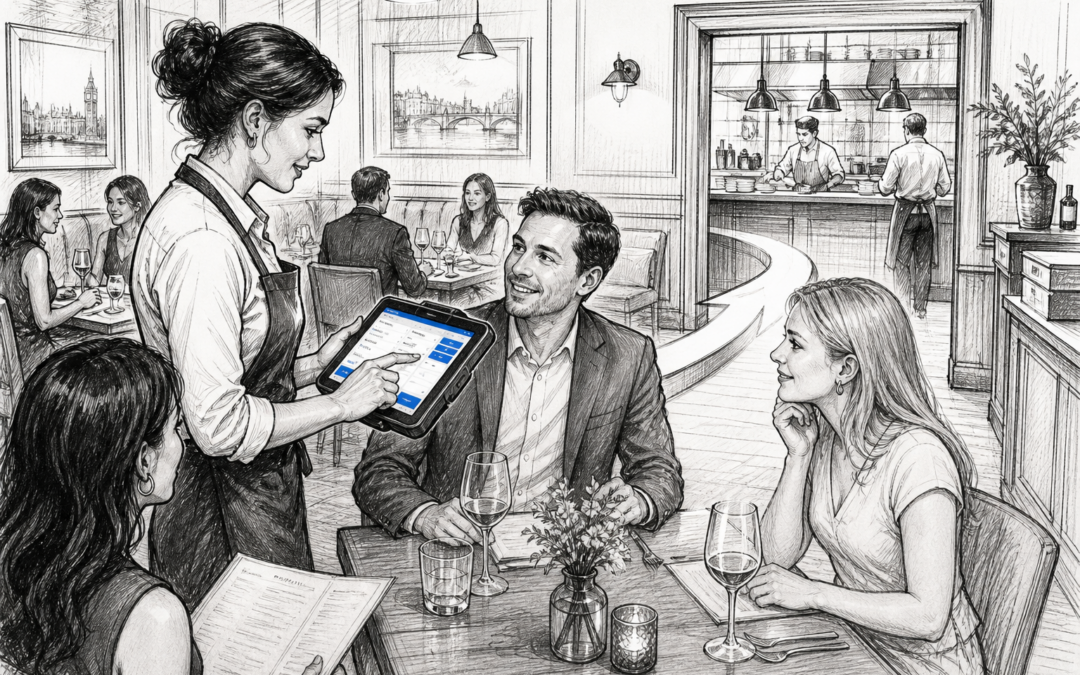
In busy UK restaurants, service speed can make a real difference to customer satisfaction, table turnover and staff workload. When the dining room fills up, every extra trip to and from the till can slow the pace of service and create pressure at the busiest points of the shift.
That is where tableside EPOS can be especially useful. Instead of relying on handwritten notes or walking back to a fixed till after every order, staff can take orders directly at the table and send them straight through to the kitchen or bar. For many restaurants, this creates a smoother and more responsive service style.
What tableside EPOS means in practice
Tableside EPOS is simply a point-of-sale system that allows staff to take payments and process orders away from the counter. In a restaurant setting, this often means using a handheld device or mobile terminal to record the order at the table, confirm item details, apply the right meal or course, and send the order immediately to the relevant prep area.
This approach is especially helpful in venues where customers expect attentive service, quicker ordering at peak times, or a more modern dining experience. It can also reduce the chance of orders being forgotten between the table and the till.
How it helps service run more smoothly
The main advantage of tableside EPOS is time. Staff spend less time walking back and forth, which means more time serving customers. Orders can be sent to the kitchen as soon as they are placed, rather than waiting for a server to return to a fixed terminal.
That can help with:
- Faster order capture during busy lunch and evening periods
- Better table attention, because staff stay with the guest for longer
- Fewer delays between ordering and kitchen preparation
- A more efficient handover between front-of-house and back-of-house teams
For restaurants that serve a mix of dine-in customers, special requests and quick meals, this can make service feel more organised and less rushed.
Reducing errors at the point of order
Service speed is important, but accuracy matters just as much. One benefit of tableside EPOS is that staff can enter the order while speaking to the customer, rather than trying to remember details later. This helps reduce mistakes caused by rushed note-taking or unclear handwriting.
It is also easier to make sure modifiers, cooking preferences and dish variations are recorded correctly. If a customer asks for no onions, a different side, or a specific preparation, that information can be captured directly at the table and passed on clearly.
Better information for the kitchen
When orders are sent digitally from the table, the kitchen receives clearer information with less room for misunderstanding. That can support quicker preparation and fewer remakes, which is useful in any restaurant trying to maintain pace during a busy service.
For UK hospitality businesses, that kind of clarity can have a big impact on day-to-day efficiency. It does not need to be complicated, but it does need to be reliable.
Why this matters for independent UK restaurants
Independent restaurants often have to balance personal service with tight staffing and busy trading periods. Tableside EPOS can help bridge that gap by making each member of staff more effective without changing the character of the venue.
It can be particularly useful in:
- Family-run restaurants with a small front-of-house team
- High-turnover lunch venues where speed matters
- Evening restaurants that need to keep orders flowing efficiently
- Hospitality businesses that want a more modern, polished service style
In other words, it is not just about technology for its own sake. It is about making service easier to manage for real people working in real venues.
Why local EPOS support still matters
For UK restaurants, good local support can be just as important as the software itself. When tableside EPOS is part of your day-to-day service, you need a system that works reliably and a support team that understands how hospitality businesses operate in the UK.
That matters when you are training new staff, opening a new site, updating menus, or dealing with a busy service and need a quick answer. A local EPOS provider can often offer more relevant advice than a generic setup, especially when your business depends on speed, accuracy and practical support.
Samtouch is a UK POS and EPOS software option designed for retail and hospitality businesses, including restaurants that want a more efficient way to manage orders. If you are looking at tableside EPOS as a way to improve service without adding unnecessary complexity, it is worth choosing a system and support team that understand the demands of UK hospitality.
Choosing the right setup for your restaurant
If you are considering tableside EPOS, start with the basics:
- Can staff learn it quickly?
- Does it suit your floor plan and service style?
- Can it handle busy periods without slowing things down?
- Does it support accurate order entry and clear kitchen communication?
The best system is the one that fits how your restaurant actually works. For some venues, that means a handheld ordering device. For others, it may mean a mix of table service and fixed terminals. Either way, the goal is the same: better service for customers and less pressure on your team.
For practical EPOS support from a UK provider, visit www.samtouch.co.uk. Contact YCR Distribution at sales@samtouch.co.uk 01924 438238.
Recent Comments