
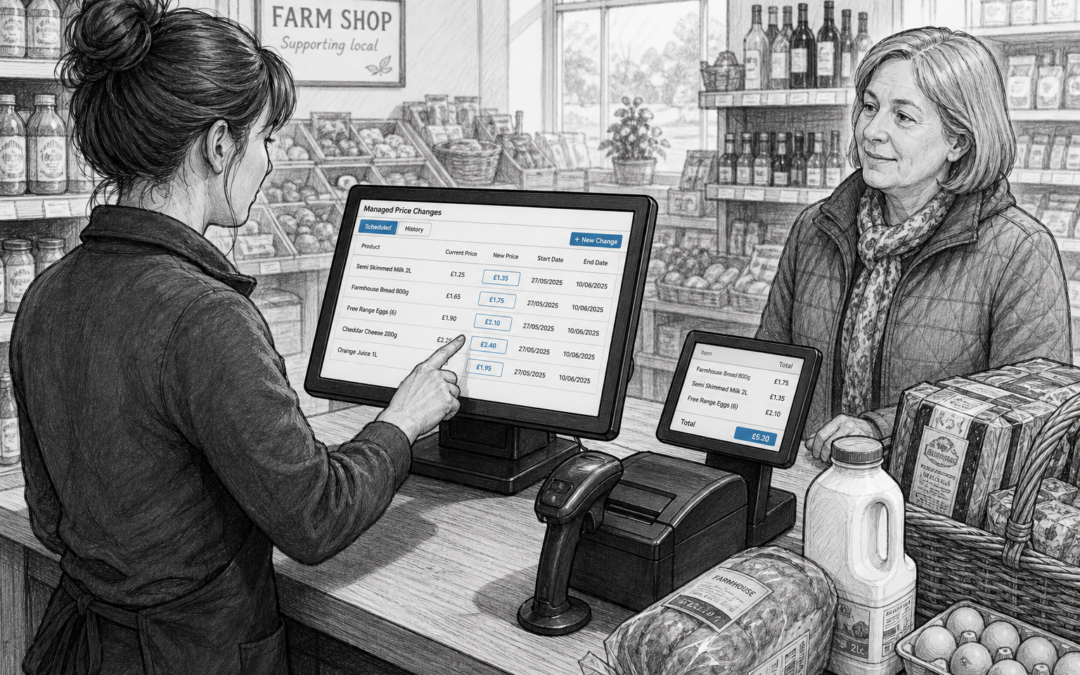
Price changes are part of everyday retail life, but they do not have to create confusion at the till. For independent shops, convenience stores, farm shops and other UK retailers, managed price changes in an EPOS system can make it easier to update selling prices in a controlled way rather than relying on manual edits or last-minute note-taking.
With Samtouch, a UK-developed EPOS software solution designed for retail and hospitality businesses, pricing updates can be handled as part of the wider till setup rather than as a separate task. The result is a more organised approach that helps staff serve customers confidently, even when prices are changing in the background.
Why manual price updates can cause problems
Many businesses still rely on a mixture of printed price lists, shelf-edge labels, memory, and quick till changes. That can work for a small number of items, but it becomes harder to manage when a shop has many product lines, frequent supplier increases, or seasonal promotions.
The problem is not just admin time. Manual price updates can lead to mismatches between shelf labels, till prices and receipts. That may create awkward moments at the checkout and extra work for staff who then have to correct the sale.
Managed price changes in an EPOS system are useful because they support a consistent process. Instead of changing prices item by item during a busy shift, businesses can plan updates and apply them in a more controlled way.
What managed price changes can help with
Depending on the business setup, Samtouch includes features designed to support scheduled price changes and other retail pricing needs. That can be helpful when prices need to move on a specific date, whether because of supplier increases, a seasonal range update or a new retail margin plan.
- Applying new prices at the right time
- Reducing the risk of inconsistent till entries
- Helping staff avoid manual overwrites during service
- Keeping pricing more organised across a product range
- Supporting a clearer audit trail of changes where relevant
For shops with a busy counter, this is especially practical. Staff can continue serving customers rather than stopping to check whether the current price on a label or notice has been updated in the system.
Useful for shops with changing ranges
Managed pricing is particularly relevant for retailers that update their stock frequently. Convenience stores, garden centres, gift shops and farm shops often carry a mix of everyday lines, seasonal products and short-run items. Prices may also change more often than in a standard high street retail setting.
That makes it useful to keep price maintenance simple and predictable. A system such as Samtouch can be discussed with a system provider to see how pricing changes should be handled for the specific business, especially where there are multiple departments or several tills in use.
Where product ranges are large, it can also be helpful to combine scheduled price changes with central product maintenance through Samtouch Office. That gives retailers a more practical way to keep item records and prices aligned across the business, rather than making repeated changes at each till.
Better for staff and customers at the checkout
Price changes become a customer service issue when checks need to be made at the last minute. By planning updates through the EPOS system, staff are less likely to be interrupted by queries over outdated labels or out-of-sync till prices.
This can support faster checkout conversations in a few simple ways:
- Staff can trust the price shown on screen
- Customers are less likely to challenge recent changes
- Managers can introduce new prices on a planned date
- Pricing is easier to explain when queried
In small shops, that kind of consistency matters. It helps the checkout feel calmer, particularly when the store is short-staffed or serving a steady stream of customers.
Why local EPOS support still matters
Pricing changes may sound straightforward, but the best approach depends on how the business trades. A local Samtouch system provider can help set up the right structure, explain how price changes should be scheduled and make sure staff know what to expect on the day they take effect.
This is one reason local support remains valuable. If a retailer needs to update several departments, or wants to avoid pricing mistakes during a busy trading period, having someone close by who understands the setup can save time and reduce stress.
Because Samtouch was developed by YCR Distribution using its experience in POS software, hardware and support, the system is positioned as part of a practical business setup rather than a one-size-fits-all package. Businesses can discuss the options relevant to their own pricing process and confirm what is suitable for the proposed installation.
Planning price changes the practical way
A good pricing process does not have to be complicated. For many retailers, the main goal is simply to make sure the till, labels and customer-facing prices stay in step. Managed price changes can help with that by making updates more deliberate and less dependent on manual action during the working day.
If you are reviewing how your retail EPOS handles pricing, it is worth thinking about when changes need to happen, who should be able to make them and how they will affect the checkout team. A system with planned pricing tools can make those answers easier to manage.
If you would like to explore pricing tools in more detail, visit www.samtouch.co.uk and see how a Samtouch setup may fit your shop.
Contact YCR Distribution at sales@samtouch.co.uk or call 01924 438238.
For retailers comparing options, managed pricing is a useful example of how a modern touchscreen till can reduce manual work without complicating daily service.
Recent Comments